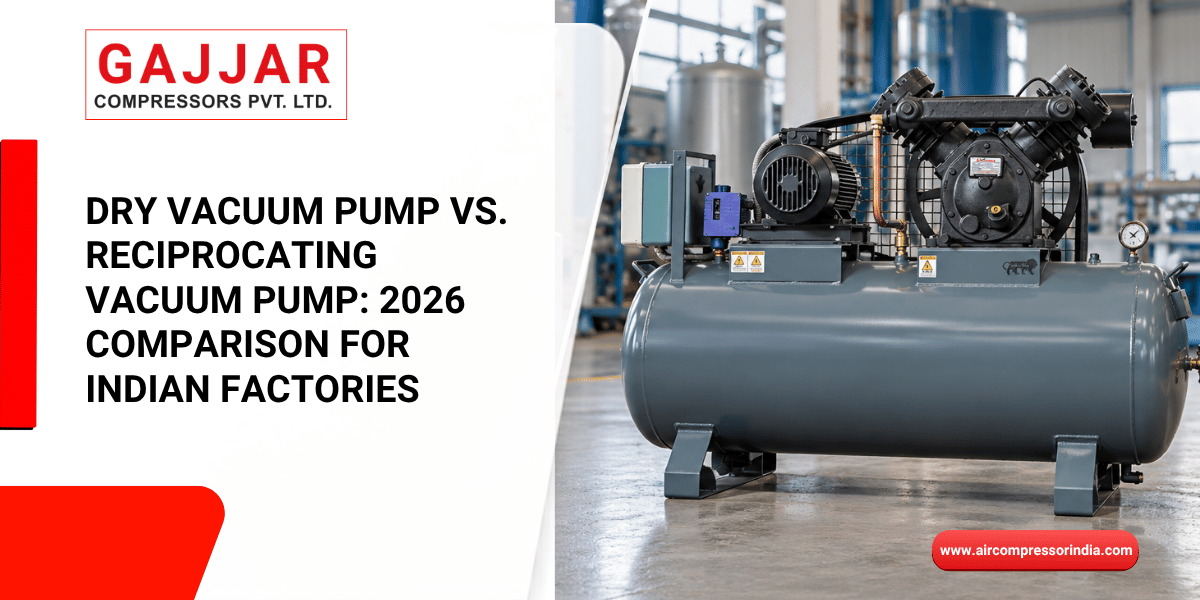
Vacuum pumps are essential equipment in many Indian industries, including pharmaceuticals, chemicals, food processing, packaging, manufacturing, laboratories, and engineering. They help remove air and gases from a system to create the required vacuum level for different industrial processes.
When selecting a vacuum pump, two commonly considered options are dry vacuum pumps and reciprocating vacuum pumps. Both technologies have different operating principles, maintenance requirements, performance characteristics, and application areas.
For Indian factories planning equipment upgrades in 2026, understanding these differences can make it easier to select a vacuum pump that matches production requirements and operating conditions.
What Is a Dry Vacuum Pump?
A dry vacuum pump produces vacuum without using oil or other lubricating fluids inside the pumping chamber.
Depending on the design, dry vacuum pumps may use technologies such as screw, scroll, claw, or diaphragm mechanisms. Since the pumping chamber does not require oil for its operation, the risk of oil contamination in the vacuum process is significantly reduced.
Dry vacuum pumps are particularly useful where clean vacuum conditions are important.
Key Advantages of Dry Vacuum Pumps
- Oil-free vacuum generation
- Lower risk of process contamination
- Cleaner operation
- Suitable for sensitive industrial processes
- Reduced oil-related maintenance
- Useful for applications requiring clean vacuum
However, the suitability of a dry pump depends on the application, required vacuum level, gas composition, operating temperature, and expected duty cycle.
What Is a Reciprocating Vacuum Pump?
A reciprocating vacuum pump uses a piston moving back and forth inside a cylinder to remove air or gas from a system.
During the suction stroke, the piston draws gas into the cylinder. During the return stroke, the gas is compressed and discharged. Repeated piston movement gradually creates the required vacuum.
Reciprocating vacuum pumps are known for their robust construction and can be suitable for applications requiring reliable vacuum generation, particularly where operating conditions are demanding.
Key Advantages of Reciprocating Vacuum Pumps
- Robust mechanical construction
- Suitable for industrial applications
- Can achieve relatively high vacuum levels depending on design
- Suitable for intermittent or specific process requirements
- Familiar technology for many maintenance teams
- Can provide reliable long-term operation when properly maintained
Dry Vacuum Pump vs. Reciprocating Vacuum Pump
The right choice depends on your production requirements rather than simply choosing the newest technology.
| Factor | Dry Vacuum Pump | Reciprocating Vacuum Pump |
| Operating Principle | Dry mechanical pumping | Piston-based reciprocating movement |
| Oil Requirement | Generally oil-free at pumping chamber | Depends on pump design |
| Contamination Risk | Low | Depends on construction and application |
| Maintenance | Generally lower oil-related maintenance | Requires inspection of moving components |
| Noise & Vibration | Depends on technology | May produce more mechanical vibration |
| Application | Clean and sensitive processes | Industrial and demanding applications |
| Gas Handling | Depends on pump design | Suitable within specified operating conditions |
| Initial Cost | Can be higher depending on technology | Can be economical for suitable applications |
| Maintenance Skill | Technology-specific | Familiar piston-based maintenance |
| Best Selection Factor | Clean vacuum and process requirements | Robust operation and application requirements |
Which Vacuum Pump Is More Energy Efficient?
Energy efficiency depends on several factors, including pump capacity, operating pressure, motor efficiency, duty cycle, system design, and maintenance.
A pump that is efficient at one operating condition may not provide the same performance at another.
Factories should therefore compare the expected energy consumption under actual operating conditions rather than relying only on rated motor power.
Before purchasing, consider:
- Required vacuum level
- Required pumping speed
- Operating hours per day
- Motor efficiency
- Load conditions
- Required ultimate vacuum
- Process gas characteristics
Proper sizing is particularly important. An oversized pump may consume unnecessary energy, while an undersized pump may have to operate continuously to meet process requirements.
Maintenance Comparison
Maintenance requirements can have a major effect on the total cost of ownership.
Dry vacuum pumps eliminate oil changes associated with oil-lubricated pumping chambers, but they are not completely maintenance-free. Filters, seals, bearings, vanes, or other components may still require inspection or replacement depending on the technology.
Reciprocating vacuum pumps require regular attention to components such as:
- Pistons
- Piston rings
- Valves
- Seals
- Bearings
- Lubrication systems
- Connecting mechanisms
Following the manufacturer’s maintenance recommendations can help prevent unexpected breakdowns and maintain consistent vacuum performance.
Application Suitability in Indian Factories
Different industries have different vacuum requirements.
Pharmaceutical Industry
Pharmaceutical manufacturing often requires clean and controlled processes. Dry vacuum technology can be suitable where avoiding oil contamination is important.
However, the final selection should consider the specific process, chemical compatibility, required vacuum level, and applicable industry requirements.
Food Processing and Packaging
Vacuum is commonly used for packaging, preservation, drying, and processing applications.
Where product contamination is a concern, dry vacuum technology can offer an advantage. However, the pump must also be capable of handling the moisture and gases associated with the application.
Chemical Industry
Chemical processes can expose vacuum pumps to aggressive gases, vapours, and chemicals.
Pump material compatibility and gas-handling capability are therefore critical. A pump should be selected based on the actual process conditions rather than only its vacuum rating.
Engineering and Manufacturing
Manufacturing applications may use vacuum for lifting, clamping, material handling, degassing, and other processes.
Reciprocating vacuum pumps can be suitable for applications where robust operation and dependable vacuum generation are important.
Initial Cost vs. Long-Term Cost
Purchase price should not be the only consideration when comparing vacuum pumps.
A lower-cost pump may become more expensive over time if it requires frequent maintenance, consumes more electricity, or experiences shorter component life.
When comparing equipment, consider the total cost of ownership, including:
- Purchase price
- Electricity consumption
- Maintenance
- Spare parts
- Lubrication
- Downtime
- Installation
- Service support
- Expected operating life
For Indian factories operating vacuum equipment for several hours each day, even small differences in operating efficiency can become significant over the equipment’s lifetime.
How to Choose the Right Vacuum Pump
Before selecting a dry or reciprocating vacuum pump, evaluate the following factors:
1. Required Vacuum Level
Determine the actual vacuum level required by the process. Avoid selecting a pump solely because it offers a deeper vacuum than necessary.
2. Pumping Speed
Check how quickly the system needs to reach the required vacuum. The required pumping speed should match the system volume and production cycle.
3. Gas and Vapour Characteristics
Identify whether the pump will handle dry air, moisture, vapours, chemicals, or other gases. This can significantly influence pump selection.
4. Operating Hours
A pump operating continuously for multiple shifts has different requirements from one used for short, intermittent cycles.
5. Maintenance Availability
Consider whether your facility has trained technicians and access to spare parts and service support.
6. Total Cost of Ownership
Compare energy consumption, maintenance, reliability, and expected service life instead of focusing only on initial purchase cost.
Why Work With an Experienced Vacuum Pump Supplier?
Selecting the right vacuum technology can be challenging because the same pump may perform differently under different process conditions.
Experienced Dry Vacuum Pump manufacturers in India can help evaluate factors such as vacuum requirements, pumping speed, operating conditions, and application compatibility before recommending suitable equipment.
Similarly, experienced Vacuum Pump manufacturers in India can provide guidance on pump selection, installation, maintenance, spare parts, and after-sales support.
For factories, technical support is especially valuable when the vacuum system is critical to production.
2026 Checklist for Indian Factories
Before purchasing a vacuum pump, ask:
- What vacuum level does the process actually require?
- What pumping speed is needed?
- Is oil-free operation necessary?
- What gases or vapours will the pump handle?
- How many hours will the pump operate each day?
- What maintenance will be required?
- Are spare parts easily available?
- What is the expected energy consumption?
- What is the total cost of ownership?
- Is technical service available in India?
Answering these questions can help avoid incorrect pump selection and unnecessary operating costs.
Conclusion
Both dry vacuum pumps and reciprocating vacuum pumps can be effective solutions for Indian industrial applications. The better choice depends on the required vacuum level, pumping speed, process conditions, contamination requirements, operating hours, maintenance capabilities, and total cost of ownership.
Dry vacuum pumps can be attractive for applications where clean, oil-free vacuum is important, while reciprocating vacuum pumps can provide robust performance for suitable industrial applications.
In 2026, Indian factories should focus on application-based selection rather than choosing equipment based only on purchase price or technology type. A properly sized and maintained vacuum pump can improve process reliability, reduce operating costs, and support long-term production efficiency.
Gajjar Compressors Pvt. Ltd.
Gajjar Compressors Pvt. Ltd. is an experienced name in the compressed air industry, providing reliable insights on industrial air compressors, air dryers, vacuum pumps, and related technologies. Our expert content is designed to help manufacturers and businesses make informed decisions, improve operational efficiency, and stay updated with the latest advancements in compressed air solutions.