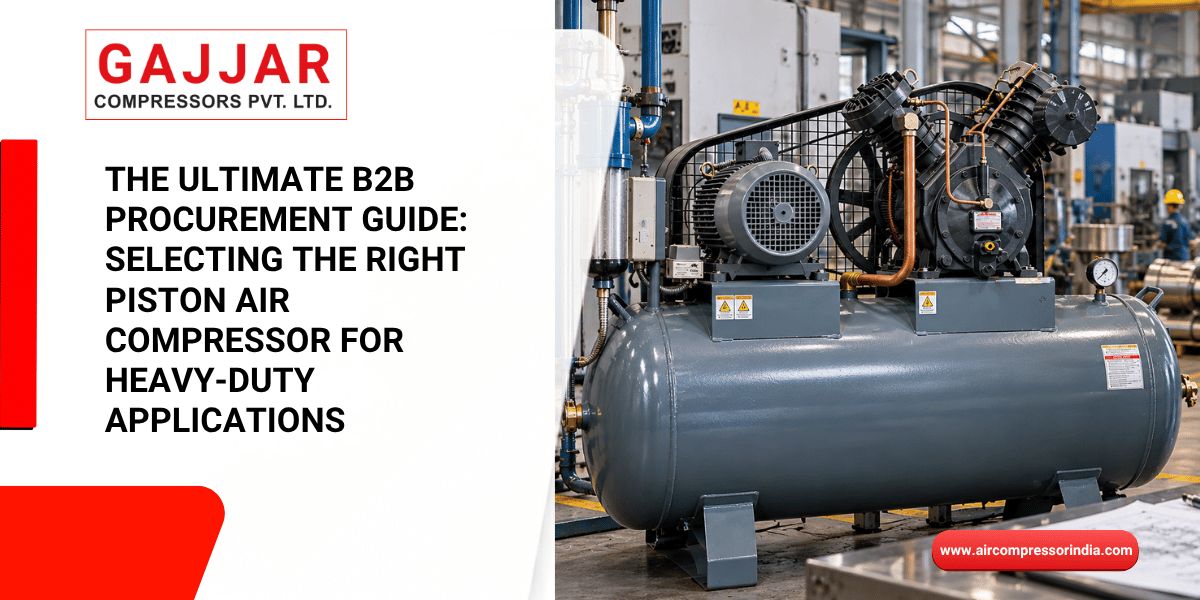
For heavy-duty industrial operations, compressed air is often an essential part of daily production. From manufacturing plants and engineering workshops to automotive units and fabrication facilities, the right air compressor can directly affect productivity, energy consumption, maintenance requirements, and operating costs.
A piston air compressor can be a practical choice for applications that require high pressure, reliable performance, and intermittent or demanding compressed-air usage. However, selecting the right model involves more than simply comparing horsepower or tank capacity.
For B2B buyers in India, procurement decisions should consider application requirements, pressure, air delivery, duty cycle, power consumption, maintenance, installation conditions, and after-sales support. This guide explains the key factors to evaluate before purchasing a piston air compressor for heavy-duty industrial applications.
1. Start With Your Application Requirements
The first step is to understand exactly how compressed air will be used in your facility.
Different applications require different pressure and airflow levels. For example, a fabrication workshop may need compressed air for pneumatic tools, while an industrial production line may require a continuous and stable air supply.
Before approaching suppliers, identify:
- Type of industrial application
- Required operating pressure
- Required air flow or FAD
- Number of pneumatic machines or tools
- Expected daily operating hours
- Required duty cycle
- Indoor or outdoor installation
- Ambient temperature and working conditions
A clear understanding of these requirements prevents under-sizing or over-sizing the compressor.
2. Check Pressure Requirements
Pressure is one of the most important specifications when selecting a piston compressor.
It is generally measured in bar or PSI. Your equipment manufacturer should specify the pressure required for proper operation.
For example, pneumatic tools may operate at relatively moderate pressures, while certain industrial processes may require higher-pressure compressed air.
When comparing models, look at both:
- Maximum pressure
- Normal operating pressure
A compressor should not be selected solely because its maximum pressure appears suitable. The system should be able to maintain the required working pressure during actual operating conditions.
3. Evaluate Air Delivery or FAD
Free Air Delivery (FAD) indicates the amount of compressed air a compressor can deliver under specified conditions. It is commonly expressed in CFM or m³/min.
This specification is particularly important for B2B procurement because two compressors with similar motor ratings may provide different air output.
Estimate the total air requirement by considering:
- Individual machine consumption
- Simultaneous equipment usage
- Leakage in the compressed-air system
- Future production expansion
- Required safety margin
Avoid selecting a compressor based only on motor HP. Air delivery and pressure should match the actual application.
4. Consider the Duty Cycle
Duty cycle describes how frequently and for how long the compressor operates.
Piston compressors are often suitable for applications involving intermittent compressed-air demand. However, heavy industrial operations may place significant demands on the compressor.
If the compressor needs to run for extended periods, procurement teams should carefully evaluate the manufacturer’s recommended operating cycle.
For demanding applications, ask the supplier about:
- Maximum recommended running hours
- Cooling arrangement
- Motor rating
- Compressor head design
- Operating temperature
- Recommended rest periods
This helps reduce the risk of excessive heat generation and premature component wear.
5. Choose Between Single-Stage and Two-Stage Compression
Piston compressors can be designed with different compression stages.
A single-stage compressor compresses air in one step, while a two-stage compressor uses multiple compression stages to achieve higher pressures more efficiently.
For applications requiring higher pressure, a two-stage configuration may be more appropriate.
The selection should depend on:
- Required pressure
- Air demand
- Operating hours
- Application type
- Energy considerations
- Manufacturer recommendations
Do not select a configuration simply because it has a higher specification. The compressor should match the actual process requirement.
6. Review Motor and Power Requirements
Electricity consumption is a major operating cost for industrial equipment.
When comparing compressors, look beyond the initial purchase price. Review the motor power, efficiency, operating conditions, and expected running hours.
Procurement teams should ask:
- What motor rating is required?
- What is the expected power consumption?
- Is the electrical supply compatible with the facility?
- Is a suitable starter or control panel included?
- What happens to energy consumption during frequent loading and unloading?
For businesses operating compressors for several hours every day, even small efficiency differences can affect long-term operating costs.
7. Check Tank or Receiver Capacity
The air receiver stores compressed air and helps manage variations in demand.
The appropriate receiver size depends on the compressor capacity, application, pressure requirement, and operating pattern.
A properly sized receiver can help:
- Handle short-term demand peaks
- Reduce frequent compressor cycling
- Stabilise system pressure
- Provide a reserve of compressed air
However, a larger tank is not automatically better. The receiver should be selected according to the complete compressed-air system.
8. Understand Maintenance Requirements
Maintenance should be considered before finalising any industrial compressor purchase.
Piston compressors generally contain components such as pistons, cylinders, valves, bearings, and lubrication systems that require periodic inspection and servicing.
Ask the supplier for a maintenance schedule covering:
- Oil changes
- Air filter replacement
- Valve inspection
- Belt inspection, where applicable
- Drainage of moisture from the receiver
- Safety valve checks
- General compressor servicing
For Indian industrial facilities, easy access to service support and replacement parts can be especially important when equipment downtime directly affects production.
9. Evaluate Installation Conditions
The operating environment can influence compressor performance.
Before installation, consider:
- Available floor space
- Ventilation
- Ambient temperature
- Dust levels
- Moisture exposure
- Noise considerations
- Electrical requirements
- Accessibility for maintenance
The compressor should be installed in a clean and adequately ventilated location whenever possible.
Heavy-duty industrial applications may also require additional air treatment equipment, such as dryers, filters, and moisture separators, depending on the quality of compressed air required.
10. Compare Supplier Support, Not Just Equipment Price
For B2B procurement, the lowest purchase price should not be the only consideration.
A compressor is a long-term industrial asset, so supplier support can have a significant impact on total ownership costs.
Evaluate the supplier based on:
- Product specifications
- Warranty terms
- Spare-parts availability
- Service network
- Installation support
- Preventive maintenance assistance
- Technical consultation
- Response time for service requirements
When evaluating piston air compressor manufacturers, procurement teams should also verify their experience with similar industrial applications and their ability to provide long-term technical support.
11. Ask for the Right Technical Documents
Before placing a purchase order, request complete technical documentation.
Important documents may include:
- Technical datasheet
- Performance specifications
- Pressure and FAD details
- Motor specifications
- Dimensional drawings
- Foundation requirements
- Electrical requirements
- Maintenance schedule
- Warranty terms
- Spare-parts information
- Installation guidelines
These documents allow engineering, maintenance, purchase, and production teams to review the same specifications before making a final procurement decision.
12. Consider Total Cost of Ownership
The purchase price is only one part of the overall cost.
A better procurement evaluation considers the total cost of ownership, including:
Purchase Cost + Installation + Electricity + Maintenance + Spare Parts + Downtime
A compressor with a lower initial price may have higher operating or maintenance expenses over its service life.
For this reason, B2B buyers should compare multiple models using both initial and long-term operating costs.
Procurement Checklist
Before finalising your piston air compressor, verify:
- Required pressure identified
- Required FAD calculated
- Duty cycle evaluated
- Motor capacity checked
- Receiver size confirmed
- Electrical requirements verified
- Installation space available
- Cooling and ventilation requirements checked
- Maintenance schedule reviewed
- Spare-parts availability confirmed
- Warranty terms understood
- After-sales support evaluated
- Total cost of ownership compared
Conclusion
Selecting a piston air compressor for a heavy-duty application requires a complete evaluation of performance, operating conditions, maintenance, energy consumption, and supplier support.
For Indian businesses, the right procurement decision should begin with the actual application rather than a focus on price or motor capacity alone. By comparing pressure, air delivery, duty cycle, receiver capacity, power requirements, maintenance needs, and long-term service support, procurement teams can select equipment that aligns with their production requirements.
A structured procurement process also makes it easier for engineering and purchase teams to compare different models and suppliers. The goal is to select a compressor that can deliver the required compressed air reliably while keeping operating and maintenance costs under control.

Gajjar Compressors Pvt. Ltd.
Gajjar Compressors Pvt. Ltd. is an experienced name in the compressed air industry, providing reliable insights on industrial air compressors, air dryers, vacuum pumps, and related technologies. Our expert content is designed to help manufacturers and businesses make informed decisions, improve operational efficiency, and stay updated with the latest advancements in compressed air solutions.