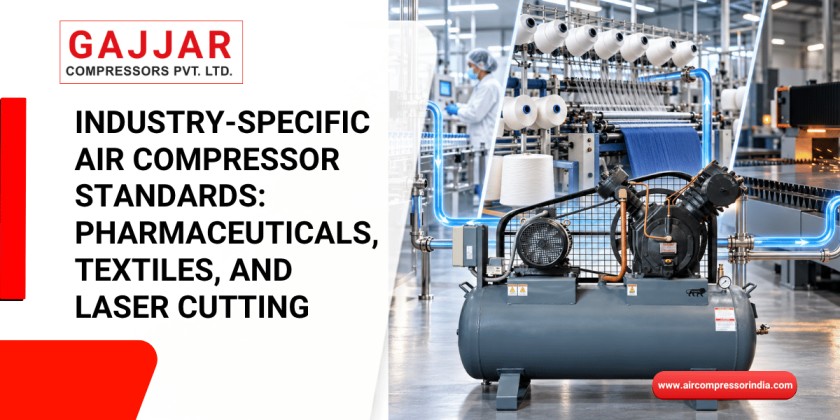
Most factory owners treat compressed air like water or electricity, just another utility. In pharma, textiles and laser cutting, though, it can make or break your product, your machines and your daily output.
So picking a system takes more than checking horsepower. You need to look at purity, pressure, moisture and the standards that apply to your work.
If you’re comparing air compressor manufacturers in Ahmedabad, knowing these needs upfront helps you avoid expensive mistakes. The compressor should fit your actual job, not just your budget.
Why Air Compressor Standards Differ by Industry
Not every process needs the same air. A medicine plant may need highly purified air. A textile unit usually cares more about steady pressure and dry air.
Laser cutting is different again, because the air works as an assist gas right at the cut.
Here’s what usually matters:
- Air purity
- Working pressure
- Dew point
- Filtration quality
- Validation records
That’s why it helps to talk through your application with experienced air compressor dealers in Ahmedabad before you finalise anything.
Pharmaceutical Air Compressor Standards
Pharma has some of the toughest air rules around. Air can touch medicines, packaging or machine surfaces, so contamination has to stay under tight control.
Air Purity and Oil-Free Operation
When air touches products or critical surfaces, purity needs to be very high. ISO 8573-1 gives a way to set limits for particles, water and oil.
Many plants prefer oil-free compressors for this reason. But an oil-free machine alone doesn’t guarantee clean air. Filters, dryers, pipes and tanks all play a part, and each needs proper selection and upkeep.
Drying and Sterile Filtration
Desiccant dryers are common when you need a very low dew point. Demanding jobs may call for a pressure dew point around −40°C.
Sterile filters add one more barrier against microbes and particles at critical points. Still, there’s no single setup for every plant. Your quality and validation team should decide the final design.
Validation Matters
In a regulated plant, the air system often sits inside a documented qualification programme. Depending on the use and the rules that apply, you may need records for:
- User Requirements Specification (URS)
- Design Qualification (DQ)
- Installation Qualification (IQ)
- Operational Qualification (OQ)
- Performance Qualification (PQ)
Remember, buying the compressor is only one part of compliance.
Textile Industry: Balancing Pressure, Purity and Moisture
Textile units use compressed air in air-jet looms, pneumatic controls, spinning and packaging. Air quality matters most when it touches yarn or fabric.
Think of the mills around Ahmedabad and Surat. A stained roll there means real money lost.
Air-Jet Looms Need Consistent Air
An air-jet loom shoots the weft yarn across using compressed air. If pressure swings, or the air carries moisture or oil, the loom stops running smoothly.
Many textile jobs run at around 5–7 bar, though it depends on the machine and process. Some applications need much more. PET bottle and certain packaging lines, for example, use booster systems for far higher pressure.
Why Moisture Can Become a Problem
Wet air causes trouble in more ways than one:
- Yarn quality issues
- Corroded pneumatic parts
- Higher maintenance
- Unstable machine behaviour
- Contaminated finished goods
A good dryer, proper filters and a well-planned drain setup matter as much as the compressor itself.
Laser Cutting: Precision Depends on Air Quality
A laser cutter needs clean, steady assist gas to blow molten metal out of the cut. When you use compressed air, its quality affects cut finish, nozzle life and running costs.
Pressure Requirements
Many fibre-laser jobs need assist-gas pressure far above normal plant air. A common setup pairs a screw compressor at about 7–10 bar with a high-pressure booster.
Depending on material, thickness and machine, needs can reach roughly 10–25 bar. Always follow the pressure your machine maker specifies.
Keep Moisture and Contaminants Under Control
Oil, dust and moisture hurt cutting performance and can dirty sensitive parts. Moisture also leads to nozzle corrosion and uneven cuts.
Pick dryers and filters based on the air-quality class and the laser maker’s advice. For demanding jobs, a pressure dew point near −20°C or lower may be specified. The right target depends on your machine and your surroundings.
How to Choose the Right Compressor for Your Industry
Before you call air compressor manufacturers in Ahmedabad, get your basic numbers ready. Check these:
- Working pressure
- Actual air demand
- Required air quality
- Dew point target
- Operating hours
- Future expansion
- Service availability
Don’t pick by horsepower alone. Look at both peak and average use.
A textile mill and a laser shop may both need a 10-bar compressor. Yet their filtering and drying needs can differ a lot.
Common Mistakes to Avoid
Choosing Only on Price
A cheap purchase can turn costly if the machine uses more power or needs frequent repairs.
Ignoring the Complete Air System
Compressor, dryer, filters, receiver, piping and drains work as one chain. One weak link drops air quality for everything downstream.
Buying Excess Capacity
An oversized unit runs inefficiently when demand is low. A proper load study beats simply buying bigger.
Neglecting Maintenance
Clogged filters, saturated dryers and leaking pipes eat into performance. Plan maintenance from day one.
FAQs
What air compressor is best for pharmaceutical manufacturing?Oil-free systems are commonly used where air can touch products or critical surfaces. The final setup should meet your air-quality specification and validation programme.
What pressure do textile machines usually need?Many run around 5–7 bar, but it depends on the machinery. Air-jet looms and specialised processes can differ.
What pressure is needed for laser cutting?Roughly 10–25 bar, depending on the machine, material and cutting conditions. A booster helps when the plant compressor can’t reach that level.
Why is a dryer important in compressed-air systems?It removes moisture. That cuts down corrosion, condensation, product contamination and pneumatic problems.
How do I choose air compressor manufacturers in Ahmedabad?Compare application knowledge, efficiency, air-quality solutions, after-sales service and spare-parts availability. Pick someone who can design the complete system, not just supply the compressor.
Conclusion
Standards differ because compressed air plays a different role in each industry. Pharma demands strict contamination control. Textiles need steady, dry air. Laser cutting needs clean assist air, often at high pressure.
If you’re evaluating air compressor manufacturers in Ahmedabad or air compressor dealers in Ahmedabad, start with your application, air-quality class, pressure and moisture needs. Compare machines after that.
Ready to plan your setup? Share your requirements with the team at Aircompressor India and get advice built around your plant.
Gajjar Compressors Pvt. Ltd.
Gajjar Compressors Pvt. Ltd. is an experienced name in the compressed air industry, providing reliable insights on industrial air compressors, air dryers, vacuum pumps, and related technologies. Our expert content is designed to help manufacturers and businesses make informed decisions, improve operational efficiency, and stay updated with the latest advancements in compressed air solutions.