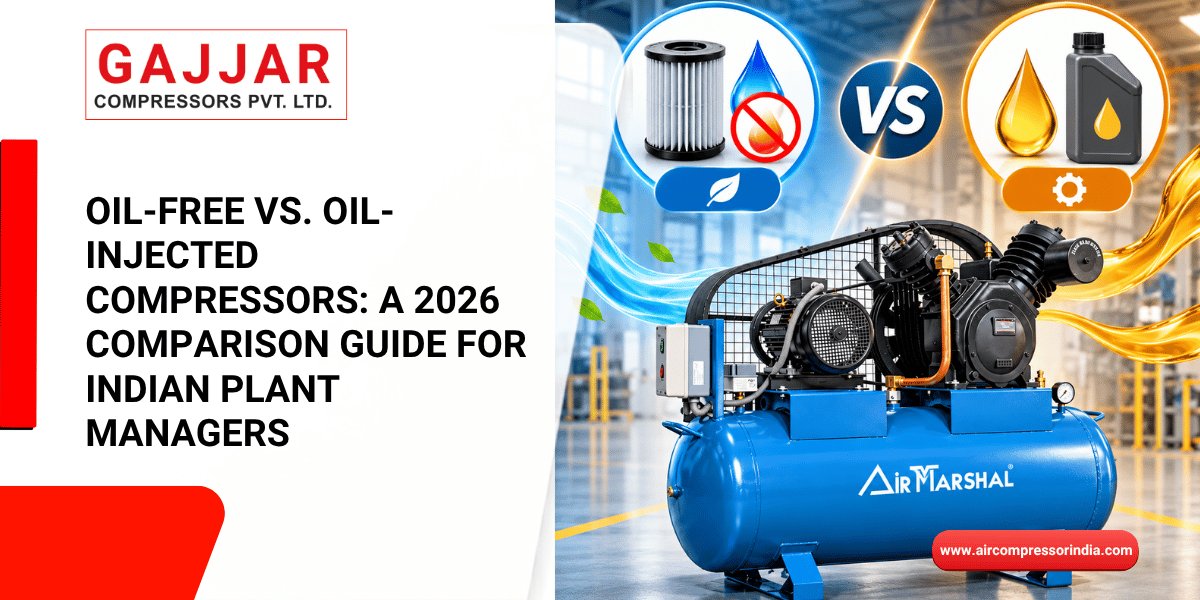
Compressed air is an important utility in many Indian manufacturing plants. It is used for pneumatic tools, automation systems, packaging equipment, pharmaceutical production, food processing, automotive manufacturing, electronics, textiles, and several other industrial applications.
When selecting a compressor, one of the most important decisions is whether to choose an oil-free compressor or an oil-injected compressor. Both technologies can provide reliable compressed air, but their construction, maintenance requirements, operating costs, and application suitability can be different.
For Indian plant managers planning new installations or compressor upgrades in 2026, understanding these differences can help them select the right equipment for their production requirements.
What Is an Oil-Free Compressor?
An oil-free compressor is designed to produce compressed air without injecting lubricating oil into the compression chamber.
Depending on the compressor technology, lubrication may still be required for certain components such as bearings or other mechanical parts. However, the compression process itself is designed to prevent oil from entering the compressed air stream.
Oil-free compressors are particularly useful in industries where air contamination could affect product quality or manufacturing processes.
Common Applications
Oil-free compressors are commonly considered for:
- Pharmaceutical manufacturing
- Food and beverage production
- Electronics manufacturing
- Medical applications
- Chemical processing
- Textile production
- Paint and coating applications
- Clean manufacturing environments
The exact suitability depends on the compressor design and required air-quality specification.
What Is an Oil-Injected Compressor?
An oil-injected compressor uses oil during the compression process. The oil helps lubricate, seal, and cool internal components.
After compression, the oil is separated from the compressed air using an appropriate separation system. Proper maintenance of filters and separators is important to maintain the required air quality.
Oil-injected compressors are widely used in general industrial applications because they can provide reliable performance and may offer an economical solution where extremely clean compressed air is not essential.
Oil-Free vs. Oil-Injected Compressors
The best option depends on the application rather than simply choosing one technology as universally better.
| Factor | Oil-Free Compressor | Oil-Injected Compressor |
| Oil in Compression Chamber | No | Yes |
| Risk of Oil Contamination | Very low when properly designed and maintained | Requires effective separation and filtration |
| Initial Investment | Can be higher | Often more economical |
| Maintenance | Technology-specific | Requires oil and separator maintenance |
| Air Quality | Suitable for applications requiring clean air | Suitable for general industrial applications |
| Cooling | Depends on compressor design | Oil assists with cooling in many designs |
| Applications | Sensitive and contamination-critical processes | General industrial applications |
| Operating Cost | Depends on technology and load | Can be competitive for many applications |
| Selection Priority | Air purity and process requirements | Cost, performance and general industrial requirements |
1. Air Quality Requirements
Air quality should be one of the first factors plant managers consider.
If compressed air comes into direct contact with food, medicine, electronics, or other sensitive products, contamination can create quality and production risks.
Oil-free technology can be advantageous when the process requires highly clean compressed air.
For general manufacturing applications where compressed air does not directly affect the product, an oil-injected compressor may provide a practical solution.
The required air-quality class should be identified before purchasing the compressor.
2. Initial Purchase Cost
Oil-free compressors can have a higher initial purchase price depending on their technology, capacity, and design.
Oil-injected compressors may offer a lower initial investment for many general-purpose industrial applications.
However, plant managers should avoid making a decision based only on purchase price.
The total cost should include:
- Initial equipment cost
- Electricity consumption
- Oil and lubricant requirements
- Filters
- Separators
- Spare parts
- Preventive maintenance
- Downtime
- Service costs
- Expected equipment life
A compressor with a higher purchase price can potentially provide better value if it matches the application and reduces contamination or maintenance-related costs.
3. Energy Efficiency
Energy consumption can represent a major portion of the lifetime cost of a compressor.
Efficiency depends on factors such as:
- Compressor technology
- Motor efficiency
- Operating pressure
- Air demand
- Load profile
- Compressor sizing
- Maintenance condition
- Leakage in the compressed-air system
Neither oil-free nor oil-injected technology should automatically be considered more energy efficient in every situation.
Plant managers should compare actual performance at the operating pressure and air demand required by their facility.
4. Maintenance Requirements
Both compressor types require regular maintenance.
For oil-injected compressors, maintenance can include:
- Oil replacement
- Oil filter replacement
- Air filter maintenance
- Oil separator replacement
- Inspection of hoses and fittings
- Cooling system maintenance
Oil-free compressors eliminate oil changes associated with the compression chamber, but they still require maintenance of filters, bearings, valves, cooling systems, seals, and other components depending on the design.
Regular maintenance helps maintain efficiency and reduce unexpected downtime.
5. Contamination Control
Contamination is an important consideration in industries where compressed air interacts directly with products or production surfaces.
An oil-injected compressor uses separation and filtration systems to reduce oil carryover. However, filters and separators need to be properly maintained.
Oil-free compressor technology can reduce the risk associated with oil entering the compression process.
Before making a decision, plant managers should identify whether oil contamination could affect the final product, process, equipment, or regulatory requirements.
6. Temperature and Operating Conditions
Industrial plants in India can experience high ambient temperatures, especially during summer.
Compressor-room temperature, ventilation, humidity, dust, and installation conditions can affect compressor performance.
Regardless of the technology selected, provide:
- Adequate ventilation
- Proper clearance around the compressor
- Clean air intake
- Suitable cooling
- Regular cleaning
- Protection from excessive dust
A compressor operating in poor environmental conditions may consume more energy and require more frequent maintenance.
7. Compressor Sizing
Correct sizing is critical for both oil-free and oil-injected compressors.
An undersized compressor may run continuously and struggle to meet production requirements. An oversized compressor may operate inefficiently when the plant’s air demand is low.
Before selecting a compressor, calculate:
- Average air demand
- Peak air demand
- Required pressure
- Daily operating hours
- Number of shifts
- Future production requirements
The compressor should be selected according to the actual demand profile of the plant.
Which Compressor Is Better for Indian Industries?
There is no single answer because different industries have different requirements.
Choose Oil-Free When:
- Compressed air comes into direct product contact
- Oil contamination must be minimized
- The process requires clean compressed air
- The facility operates in a contamination-sensitive industry
- Air purity is a major production requirement
Consider Oil-Injected When:
- The application is general industrial manufacturing
- Compressed air does not directly contact the product
- Initial equipment cost is an important consideration
- Oil separation and filtration can meet the required air quality
- The application requires robust general-purpose compressed air
What Should Plant Managers Check Before Buying?
Before selecting a compressor in 2026, review these points:
Application
Understand exactly where compressed air will be used and whether it will contact the final product.
Pressure
Determine the actual pressure required by production equipment. Avoid operating at unnecessarily high pressure.
Air Flow
Calculate both average and peak compressed-air requirements.
Air Quality
Identify the required air-quality level before choosing the compressor technology.
Energy Consumption
Compare expected electricity consumption under actual plant operating conditions.
Maintenance
Check maintenance intervals, spare parts availability, service support, and technician requirements.
Total Cost of Ownership
Consider the complete lifetime cost rather than only the purchase price.
Working With the Right Compressor Manufacturer
Selecting the right technology can be easier when the manufacturer understands the application’s requirements.
When evaluating oil free compressor manufacturers in india, plant managers should review manufacturing experience, compressor technology, air-quality capabilities, energy performance, service support, spare-parts availability, warranty terms, and technical assistance.
A reliable manufacturer should be able to explain how the compressor will perform under the plant’s actual operating conditions instead of recommending equipment based only on capacity.
2026 Checklist for Plant Managers
Before finalizing a compressor, ask:
- What air pressure does the process require?
- What is the average and peak air demand?
- Does compressed air contact the product?
- What air-quality specification is required?
- What are the expected electricity costs?
- How frequently will maintenance be required?
- Are spare parts easily available?
- What is the compressor’s expected operating life?
- What service support is available?
- What is the total cost of ownership?
Conclusion
Oil-free and oil-injected compressors can both be effective solutions for Indian industrial plants. The right choice depends on air-quality requirements, application, operating pressure, air demand, maintenance capabilities, energy consumption, and overall cost.
Oil-free compressors can be particularly valuable for contamination-sensitive applications, while oil-injected compressors can provide a practical and economical solution for many general industrial operations.
For plant managers in 2026, the best approach is to evaluate the complete compressed-air system rather than selecting a compressor based solely on purchase price. Proper sizing, regular maintenance, efficient operation, and appropriate air treatment can help improve compressor performance, reduce operating costs, and support reliable production.
Gajjar Compressors Pvt. Ltd.
Gajjar Compressors Pvt. Ltd. is an experienced name in the compressed air industry, providing reliable insights on industrial air compressors, air dryers, vacuum pumps, and related technologies. Our expert content is designed to help manufacturers and businesses make informed decisions, improve operational efficiency, and stay updated with the latest advancements in compressed air solutions.